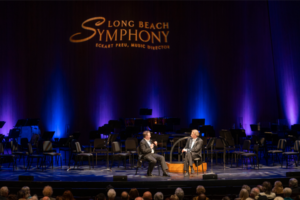
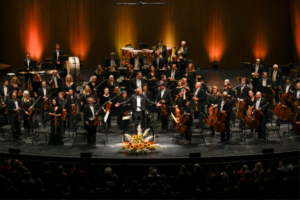
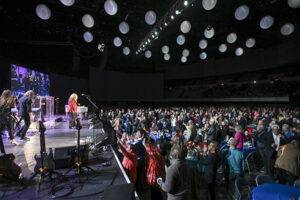
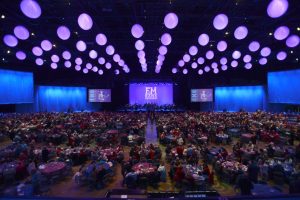
At the start of the 2010-2011 concert season, Music Director Enrique Arturo Diemecke met with Long Beach Symphony Orchestra staff for an interview regarding his 10 Year Anniversary as the music director of the Long Beach Symphony Orchestra. The setting was casual and the sentiment was sincere. This interview reflects the conversation.
PART 1: REFLECTION
In reflecting upon the triumphant anniversary mark of 10 years as our music director…
Q: You began your tenure in Long Beach promising to bring “Music with Passion”, and now, 10 seasons later, it appears that the audience not only appreciates your passion but they expect it. What has been the key to your success in establishing this connection with our audience?
A: Well I always keep my promises. And I said I was going to bring music with passion, but not just the music being with passion, but us being passionate about it. And I wanted to convert our audience into passionate people—and for them to be able to express themselves and to be able to enjoy and to be able to not conform to anything or anybody—that they don’t have to be intimidated by anything. This is a place where we are all coming to express ourselves—to have fun, to enjoy, to work out things that we probably don’t have a chance to do—meaning feelings. The Greek’s knew it when they created theater and said that they wanted a contrast between the smile and the frown, because they wanted to have a catharsis when it was needed. I think in a concert hall it is the same approach. We haven’t changed much since ancient times. We need to continue to be human beings with emotion or else we are not going to have hope.
Q: Do you think that passion is still your defining characteristic as our music director? If not, what is?
I definitely think that passion is still my motto. I still keep that as the key of doing what I’m doing because I also have to keep our musician in the same tune—to be passionate about playing music and not to forget that we chose to be musicians because we love it—because we passionately crave it. It is not an accident that we have this job—there are many jobs available that probably pay more than this one. So what are you doing this for if it’s not for your passion, and not for your soul, and not for your way of expressing to your friends and family—to everyone around you and even to your own self? Passion is the key to everything.
A: I believe that if we can passionately approach our music with intelligence and the desire to give ourselves fully—with no strings attached—so that both pleasure and a greater understanding of life is achieved, then we have succeeded!
Q: What makes the Long Beach Symphony Orchestra musicians unique from the many other musicians around the world that you lead?
A: We have a great pool of musicians in this area, because of the studios and because of the offers that this area is capable of giving. But when they see a situation that is giving them an opportunity to be artists, to be musicians, to be themselves, to create something special and unique—that is what makes them come here to Long Beach. I think that experience of sharing in the concert with the audience, with the community, makes our diversely-talented musicians come back year after year—concert after concert.
Q: In reflection, what do you feel is the greatest artistic accomplishment of the Orchestra (the musicians) in your tenure?
A: I could say that we have been capable of making every concert special but also that every concert is always named as the best concert of the season. You know, that is wonderful. That means that we are accomplishing something. That we learn from the previous concert; that we learn
how to deliver the maximum and also learn how to continue to make it better. We are not jaded, not sitting back, not resting on our laurels. We take only the last concert as the model to follow. So that learning experience for the orchestra has probably been the BEST of all.
Q: What is the greatest accomplishment of the audience in Long Beach? And do you see the audience now in different light than you did when you began your tenure?
A: Yes, I have seen that our audience has become more comfortable with showing their appreciation. They stopped being concerned with proper behavior and clapping one or two times and thinking, “Oh, let our musicians go home and rest because they have worked so hard.” They are willing to stand up and cheer and scream when they feel that have heard a piece that has moved them, and they are willing to give appreciation for works that they feel were not exactly in the main stream repertoire, or works that present an introspective experience (a catharsis).
Q: In your opinion, what are the critical ingredients to programming a successful concert, for our audience, here in Long Beach (and for the musicians)?
A: Well the greatest challenge to our audience is to peak their interest in each program—that they cannot be scared because they see a name that is not recognized, or they see an instrument that is not piano or violin. Our audience has learned that there is more out there—that there is universe of things that we are exploring and haven’t explored, and that they can have it right here in their backyard with just a 10 minute drive with not so much traffic.
The programming has to bring the people who know about the traditional composers and to bring people who want to know more about some new composers, and they can enhance their palate and their knowledge. The other key is to help newcomers not feel afraid to hear something unfamiliar. The end result in all cases is that the music is going to bring joy, bring some fun and ultimately a craving for knowledge. The programming key is to find a mix that conveys this experience to all of the audience.
Q: Music Education is a mission-critical element of the Long Beach Symphony Orchestra. Why is this important to you personally?
A: To me the most important thing for any human being is to have the opportunity to have great education. We are lucky to have a very good education system in Long Beach that allows us to have 150+ concerts in the schools so kids can hear a professional performing and explaining the craft of making music with their instrument—so kids can be exposed at a very early age to something that is so wonderful and so incredible. I believe strongly that a healthy community is the one that has the highest possible music education included. Because that means the humanities that brings the part that we all need to understand the contrasts—the yin-yang—the positive or negative things that we put together (like electricity, for example). So music education can take us to the other exciting part of what sports can do.
Q: As you reflect upon the many grand moments of music making in Long Beach, what moment has brought you the most fulfillment?
A: I think every time I am getting up in the morning and I know I have to prepare myself for the day, and I am studying my score and preparing them, the whole enjoyment is beginning to grow and is beginning to flow in my veins. It goes in my breathing. So the most glorious moment is when we accomplish all that at the end of the week when the last note is being hit, is being played, and is getting the cut off. “Aaaaahhhhhh!!!!! [crowd cheers]” That is the greatest moment! That is the greatest joy that one as a musician can ever, ever expect! Now if we have audiences that respond to all of that and give the applause, then they are not the passives anymore they are the actives. And that is even greater because that means everyone in that concert hall has achieved that greatest moment because we connected. So for me that is the biggest moment—that I was in charge of putting the plug in the socket and it worked! It worked and everyone worked together to make it work—from the wires to the light bulbs to the music parts on the stands to welcoming everybody in the concert hall. And in the end everyone goes home recharged. That is the greatest moment for me.
(The exact reason why I cannot stop doing it is because I have the opportunity to do it over and over again each season.)
PART 2: PROJECTION
In projection of the upcoming season and continued relationship with Long Beach…
Q: What is your vision for the future of the Long Beach Symphony Orchestra?
A: My vision is to really accomplish what a symphony orchestra is made for. A symphony orchestra is to bring a community up to a level that if they have a great symphony orchestra, great music making, that they are a very healthy community. So I want to continue having the orchestra going and not to risk its quality. Every single concert of the community should be the night of the Oscars, the Super Bowl, the last game of the World Series, the Olympics…it has to be the most important gathering of the year, an opportunity for Long Beach to really have the best of the best. And for that the whole community has to work together.
Q: The art of music is a living gift that reaches the musicians and the audience in such vast ways. With that said, is there something in particular that you wish to gift, or educate, the audience with in the upcoming seasons?
A: I want to probably explore something I’ve done in other places where I conduct. My way of talking many times is to try to reach the majority of the people, and the majority of what I care about is to break the fourth wall—that is the so-called wall between the audience and the musicians. I don’t want to have any barrier. We are all together in the concert hall. We all belong there. This is not an egocentric place, this is for everybody. We are all sharing. We do everything we can in the 2 ½ hours that we have while we are gathered. And I think I am going to become a little bolder about talking from the stage and breaking the fourth wall.
Q: Long Beach has had the honor of performing some of your compositions. Do you plan on bringing more of your works in the near future?
A: Yes. I am working on a couple of pieces and I think for next season you are going to see a new work I’m writing. It’s a concerto—it’s going to be fun. It’s going to be for an instrumentalist but I’m not going to tell you which because that would give up everything!
Q: What are your plans for the education programs of the Long Beach Symphony Orchestra?
A: You know that the challenge is that normally when you talk about special projects you are talking about money. I hope that we are first able to get back into better economic shape so that we can bring back some of the programs we have had and then explore the programs I have talked about. We should not diminish our programs, we should grow them! We should be giving more, but unfortunately we have cut the programs instead of growing them. I hope that we can enhance our programs, our concerts to the kids because that’s our future. Children reach at least two other people each because they talk to parents and grandparents. And if we are going to talk about our future, it relies on the kids.
Q: How can Long Beach best support you as our music director?
A: To see me as one more citizen, one more person in the community, but see that I have the opportunity to lead a vital organization in the community. What I’ve been given is the idea that a healthy city is the one that has a healthy orchestra—that really shows immediately to the world what kind of a community you have. I want to send a message to EVERY leader in the community, and the political leaders, that if you really passionately love your city you need to support the arts! You need to support the symphony orchestra and you need to show that you come to the concerts. You need to be the first ones sitting there and then you are pulling other people there. Because this is your city! When you talk about big name cities—Paris, London, New York, Berlin, Buenos Aires, Tokyo—they all have great symphony orchestras. We cannot allow our greatest organization to perish. Because what happens when they perish? Remember the Titanic—who were the last people getting into the life boats? The musicians! Because without the music there was no hope. And once the music stopped, life was dead. So, keep the spirit! And lead by example! And let’s keep the music with passion!